At What Age Should You Start Mammograms, and How Often?
Most women at average risk are advised to start screening mammograms at age 40 and repeat them every two years through age 74, according to the 2024 federal task force recommendation on breast cancer screening.
Written By: DocAi Health Editorial Team
Last Updated: 2026-10-01
Most women at average risk are advised to start screening mammograms at age 40 and repeat them every two years through age 74, according to the 2024 federal task force recommendation on breast cancer screening. The American Cancer Society offers yearly screening from 45 to 54, with the option to start at 40, then every other year from 55. Family history, a known gene change or earlier chest radiation can move your plan earlier. This article covers what changes your timing and which breast symptoms need a visit sooner.
When to start mammograms: the age ranges
A screening mammogram is an X-ray picture of the breasts taken when you have no symptoms, with the goal of finding cancer early. Guidelines agree on the general idea but differ slightly on the details, which is why the answer can sound inconsistent from one source to the next.
The 2024 federal task force recommendation advises screening every two years for women at average risk from age 40 to 74, and gives it a B grade. Earlier versions of that guideline began at 50, so many women in their 40s have heard conflicting advice. A focus group study of women in their 40s describes how confusing that change has been for patients.
The American Cancer Society's 2015 guideline for women at average risk takes a somewhat different route. It says women 40 to 44 should have the option to begin yearly screening, recommends yearly screening from 45 to 54, and then lets women choose every other year or continued yearly screening from 55. You can read the details in its 2015 guideline update, and check the American Cancer Society's site for any newer update.
"Average risk" matters in all of these. It generally describes someone without a strong family history, a known breast cancer gene change, or past radiation to the chest at a young age. If any of those apply to you, the age ranges above may not fit, and a different plan is discussed later in this article.
How often should you get a mammogram?
Every two years and every year are both reasonable, depending on which guideline you and your clinician follow. The 2024 federal task force update favors every two years across the 40 to 74 range. The American Cancer Society suggests yearly screening for ages 45 to 54 and gives the option of every other year afterward.
Why the difference? Screening more often can find some cancers sooner, and it also means more false alarms, more callbacks, more follow-up imaging and some risk of overdiagnosis, which is finding cancers that would never have caused problems. Different expert groups weigh those tradeoffs differently, and the evidence leaves room for reasonable disagreement. Your own preferences count. Some women value the extra reassurance of a yearly test, and others prefer to avoid repeat callbacks.
Tell your clinician your age, your family history and how you feel about those tradeoffs, so you can settle on a schedule together. MedlinePlus has a patient overview of mammography that explains what the test can and cannot show.
When can you stop screening?
The 2024 federal task force recommendation covers routine screening through age 74 and concluded that the evidence is insufficient (an I statement) for women 75 and older. The American Cancer Society's 2015 guideline says screening can continue while a woman is in good health and has a life expectancy of at least 10 years; check the American Cancer Society's site for any newer update.
After 74, evidence about benefits and harms is thinner. Overall health, other medical conditions and personal preferences carry more weight in the decision. This is a good conversation to have with the clinician who knows your history.
What can move your mammogram schedule earlier
Several things can raise breast cancer risk enough that clinicians consider starting earlier, screening more often or adding another type of imaging. These include:
- A known inherited gene change linked to breast cancer, such as BRCA1 or BRCA2, in you or a close relative.
- A mother, sister or daughter diagnosed with breast cancer, especially at a younger age or in both breasts.
- Radiation therapy to the chest during childhood or young adulthood, for example to treat lymphoma.
- A personal history of breast cancer or of certain biopsy findings that raise future risk.
Having one of these does not mean you will develop breast cancer, and many people who develop it have none of them. The point is that standard average-risk ages may not suit you. If the family history is unclear, genetic counseling can help sort out whether testing makes sense. MedlinePlus explains what genetic counseling involves.
Tell your clinician about relatives with breast, ovarian, prostate or pancreatic cancer, including their ages at diagnosis if you know them. For women at high lifetime risk, American Cancer Society guidance on breast MRI may advise adding yearly MRI to mammography. Your clinician can estimate your risk and decide what is appropriate for you.
Dense breasts and what the report may say
Breast density describes how much of the breast is glandular and fibrous tissue compared with fat. It is seen on the mammogram, not felt by hand, and it is common. Dense tissue can make small cancers harder to see on the image, and density is also associated with a somewhat higher cancer risk.
Your mammogram report may mention density. If it does, you can ask your clinician what it means for you. Whether extra imaging, such as ultrasound or MRI, is helpful depends on your overall risk and on what the evidence supports for your situation, so that decision is best made with your clinician. Insurance coverage for additional imaging varies.
What happens at the appointment
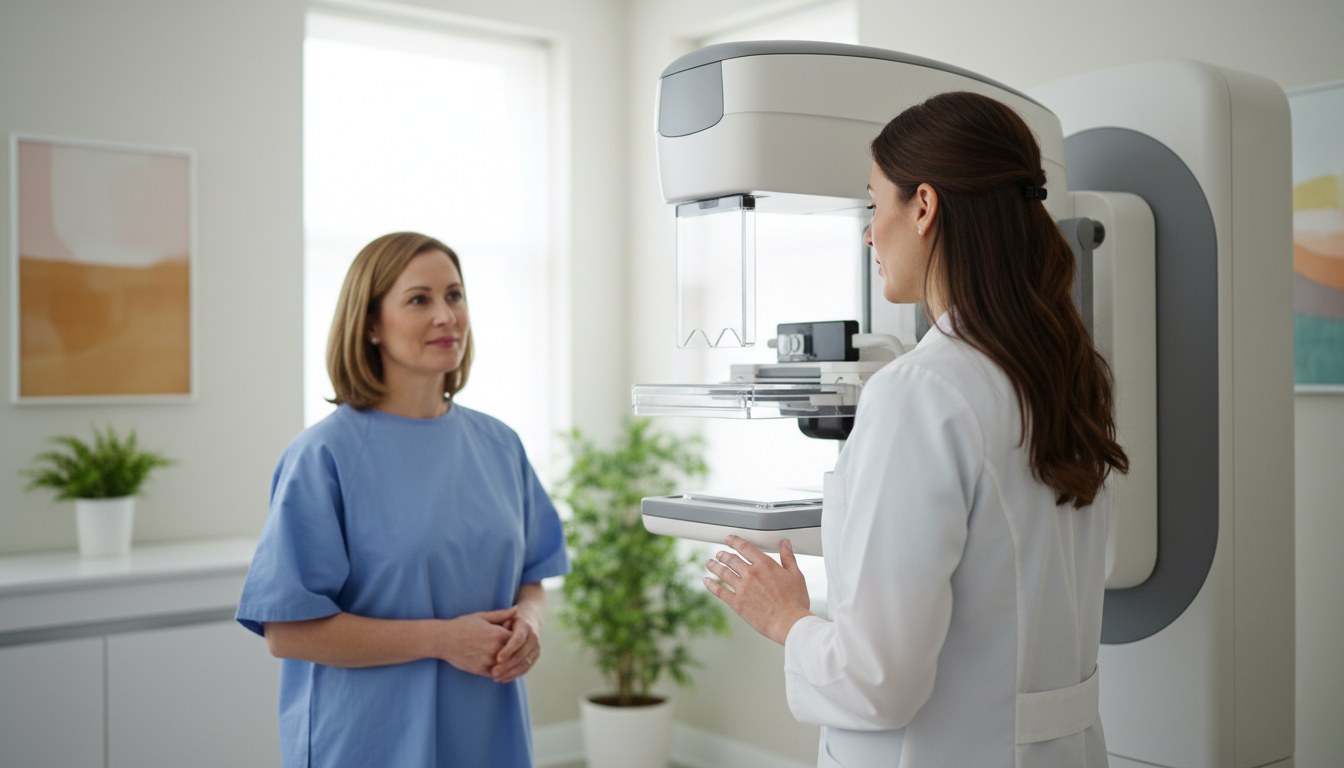
A screening mammogram usually takes a short time. A technologist positions each breast on a platform and gently compresses it with a clear plate for a few seconds while the image is taken. Compression can be uncomfortable and for some women it is painful, but it does not last long. Compression spreads the tissue out, which helps the radiologist see clearly and allows a lower radiation dose.
A few practical steps may make it easier:
- Tell the technologist about breast implants, past surgery or any new lump or symptom before the pictures start.
- Wear a two-piece outfit so you only need to undress from the waist up.
- If your breasts are tender before your period, you may prefer to schedule the test for the week after it ends.
- Bring prior images or ask your clinician to request them if you had a mammogram at another facility, so the radiologist can compare.
- Some centers offer 3D mammography, also called tomosynthesis. Ask your clinician or the imaging center whether it is available and covered for you.
If your results come back "abnormal"
A callback after a screening mammogram is common, and most callbacks do not end in a cancer diagnosis. The radiologist may simply need a closer look at an area, with a diagnostic mammogram, an ultrasound or sometimes a biopsy. Many of these areas turn out to be normal tissue or benign (noncancerous) changes such as cysts.
It can still be stressful to wait. Clinicians combine your history, an examination and imaging, and sometimes a tissue sample, to understand what an area represents. Ask the imaging center how and when you will hear results, and keep the follow-up appointment even if you feel fine.
A screening mammogram differs from a diagnostic one. Screening is for people without symptoms. A diagnostic mammogram is used to evaluate a lump, nipple discharge or another change, or to follow up an unclear screening result.
Breast symptoms need attention whatever your last mammogram showed
A normal mammogram does not rule out a problem that appears later. Between screenings, tell a clinician about new changes, including:
- A new lump or thickened area in the breast or underarm.
- Skin changes such as dimpling, puckering, redness or an orange-peel texture.
- Nipple changes, such as turning inward, or discharge that is bloody or comes from only one breast without squeezing.
- A change in the size or shape of one breast, or persistent pain in one spot.
Most breast lumps turn out to be benign, but only an evaluation can sort that out. Do not wait for your next scheduled mammogram. MedlinePlus lists common breast conditions and how breast cancer is found and treated.
When a breast problem needs urgent care
Breast cancer screening itself is not an emergency, and most breast changes are not either. A few situations call for faster action. A painful, red, swollen breast with fever can reflect an infection or abscess (a pocket of pus) that can progress quickly and needs same-day evaluation; if you cannot be seen the same day, go to urgent care or the emergency room. If the infection spreads through the body, it can cause confusion, a fast heartbeat, shaking chills or faintness, which require emergency care.
Sudden severe shortness of breath or chest pain needs emergency care in anyone, and in a person with known breast cancer a blood clot or lung involvement is possible. In people who already have a breast cancer diagnosis, a seizure, new weakness on one side of the body, sudden confusion, a severe headache with repeated vomiting, or sudden vision changes can signal that cancer or a complication such as a blood clot is affecting the lungs or brain. These are uncommon, and in most people with breast symptoms the cause is something other than cancer spread, but they still need emergency evaluation.
Two other emergencies are specific to people with known breast cancer. First, a temperature of 100.4°F (38°C) or higher, or shaking chills, during chemotherapy can be a sign of febrile neutropenia, a low white blood cell count with infection that can become life-threatening. Call your oncology team or go to the emergency room right away. Second, breast cancer can spread to the spine, and a tumor there may press on the spinal cord. New back or neck pain together with leg or arm weakness or numbness, or new loss of bladder or bowel control, needs emergency evaluation because early treatment gives the best chance of preserving nerve function. The emergency box below lists these warning signs in full.
Cost, access and getting it scheduled
Many insurance plans cover screening mammograms, but the age at which coverage begins and the follow-up costs can differ by plan, state and program. Researchers have found that insurance status, financial strain and rural residence are associated with whether women receive guideline-based mammograms, as described in this study of insurance, financial hardship and rurality.
If cost or distance is a barrier, call your clinic, your insurer or a local imaging center and ask about coverage, sliding-scale programs and mobile screening services. MedlinePlus keeps a page on health screening that gives context for other recommended tests. Many women can book a screening mammogram without a visit first, but policies vary, so check with the facility.
How to decide with your clinician
Because guidelines differ, a short, specific conversation is more useful than a search for the one right answer. Consider bringing:
- Your age and the date of your last mammogram, if any.
- Any relatives with breast, ovarian or other cancers, and their ages at diagnosis.
- Any past chest radiation, breast biopsies or genetic test results.
- Your own preferences about how often to be screened and how you feel about callbacks.
With that information, your clinician can tell you whether you fit the average-risk ranges or need a different plan.
When to Seek Medical Care
When to Seek Urgent or Emergency Care
Routine mammograms are not an emergency, and most breast changes can be checked at a regular visit. The list below covers the uncommon situations where a breast problem, or a known breast cancer, needs emergency care right away. This guidance is in addition to, not a replacement for, the general disclaimer above.
Emergency, call 911 or go to the emergency room immediately if:
- Sudden severe shortness of breath or chest pain, in anyone and especially in someone with known breast cancer, where a blood clot or lung involvement is possible and emergency care is needed.
- A painful, red, swollen breast with fever along with confusion, fainting, a very fast heartbeat or shaking chills, which may signal infection spreading through the body.
- A seizure, sudden confusion, new weakness or numbness on one side of the body or face, or a severe headache with repeated vomiting or sudden vision changes in someone with known breast cancer.
- A temperature of 100.4°F (38°C) or higher, or shaking chills, in someone receiving chemotherapy for breast cancer, which can mean a dangerous infection; call the oncology team or go to the emergency room right away.
- New back or neck pain together with leg or arm weakness or numbness, or new loss of bladder or bowel control, in someone with known breast cancer, which can reflect spinal cord compression.
See a doctor soon (same-day or next available appointment) if:
- A new breast lump or thickened area, in the breast or underarm, even if your last mammogram was normal; contact your clinician soon to arrange a diagnostic evaluation instead of waiting for your next screening.
- Skin changes on a breast such as dimpling, redness, an orange-peel texture or a rash that does not heal, which need prompt evaluation.
- Nipple discharge that is bloody, or that comes from one breast without squeezing, or a nipple that has newly turned inward.
- A breast that is warm, red and painful, especially with a fever, which needs same-day evaluation; go to urgent care or the emergency room if you cannot be seen the same day.
- A callback after a screening mammogram, which is not an emergency but needs diagnostic imaging arranged through your clinician or the imaging center, so do not let the follow-up slide.
- A close relative newly diagnosed with breast or ovarian cancer, so you can ask your clinician whether your screening plan or genetic counseling should change.
Frequently Asked Questions
Should I start mammograms at 40 or 50?
The 2024 federal task force recommendation advises screening every two years from age 40 for women at average risk, while older versions began at 50. The American Cancer Society's 2015 guideline offers the option of starting at 40 and recommends yearly screening from 45. Your clinician can help you choose based on your own risk.
How often do I need a mammogram?
It depends on the guideline and your risk. The 2024 federal task force recommendation advises every two years from 40 to 74 for women at average risk. The American Cancer Society suggests yearly screening from 45 to 54, then every other year or continued yearly screening from 55. Higher-risk women may be advised to screen more often.
Does a mammogram hurt?
Experiences vary. Many women describe pressure or brief discomfort while the breast is compressed, and for some it is painful. Compression lasts only a few seconds per image. Scheduling the test for the week after your period, when breasts are often less tender, may help. Tell the technologist if you are in pain so they can adjust.
What does it mean if I get called back after a mammogram?
A callback means the radiologist wants a closer look at an area, often with extra mammogram views or an ultrasound. Callbacks are common, and most do not lead to a cancer diagnosis. Many areas turn out to be normal tissue or benign changes such as cysts. Keep the follow-up appointment so your clinician can explain what was found.
Should I start mammograms earlier if breast cancer runs in my family?
It may be appropriate. A mother, sister or daughter with breast cancer, a known BRCA1 or BRCA2 gene change, or past chest radiation can change when screening starts and what type of imaging is used. Tell your clinician about relatives and their ages at diagnosis so they can estimate your risk and recommend a plan.
Do dense breasts mean I have cancer?
No. Dense breasts are common and are not a diagnosis. Density describes the mix of glandular and fatty tissue seen on a mammogram. It can make small cancers harder to see and is associated with a somewhat higher cancer risk. Ask your clinician whether extra imaging such as ultrasound or MRI makes sense for your situation.
Can I get a mammogram if I have breast implants?
Yes, screening is generally still possible with implants. Tell the scheduler and the technologist about them in advance, because extra views are sometimes needed so more breast tissue can be seen. Bring any information you have about the type of implant and when it was placed, and ask your clinician if you have questions.
Related articles
Why Should Any Bleeding After Menopause Always Be Checked?Perimenopause or Something Else? Symptoms That OverlapManaging Hot Flashes During Menopause: What Actually HelpsSources
- MedlinePlus (NIH) - Mammography
- MedlinePlus (NIH) - Breast Cancer
- MedlinePlus (NIH) - Breast Diseases
- MedlinePlus (NIH) - Health Screening
- MedlinePlus (NIH) - Genetic Counseling
- PubMed Central (NIH) - Women in their 40s responding to the 2024 United States Preventive Services Task Force mammography guideline update: a focus group study
- PubMed Central (NIH) - Breast Cancer Screening for Women at Average Risk: 2015 Guideline Update From the American Cancer Society
- PubMed Central (NIH) - Associations between Insurance Status, Financial Hardship, and Rurality on Receipt of Guideline-Concordant Mammography