Early Signs of Osteoporosis Before a Fracture Happens
Osteoporosis usually causes no pain until a bone gives way, so the earliest signs are physical changes rather than symptoms: losing height, an upper back that rounds forward, a waistband that suddenly rides higher, or sharp mid-back pain that starts during a small movement like lifting groceries.
Written By: DocAi Health Editorial Team
Last Updated: 2026-08-03
Osteoporosis usually causes no pain until a bone gives way, so the earliest signs are physical changes rather than symptoms: losing height, an upper back that rounds forward, a waistband that suddenly rides higher, or sharp mid-back pain that starts during a small movement like lifting groceries. A wrist, rib, or hip broken by a minor fall after age 50 is often the first real announcement. This guide covers the clues that appear before that fracture and who should be screened.
Why the First Years of Bone Loss Are Silent
Bone is living tissue, torn down and rebuilt continuously. Cells called osteoclasts dissolve patches of old bone; osteoblasts refill each cavity. Through your twenties the rebuilding side wins, bone mass peaks around age 30, then removal slowly outpaces replacement. In women the loss speeds up sharply in the first five to ten years after menopause, because estrogen brakes the cells that dissolve bone and menopause releases that brake. Men lose bone more gradually and usually fracture about a decade later.
Why you feel none of it. The honeycomb interior of a vertebra, trabecular bone, carries no nerve endings reporting on how thick its struts are. Those struts thin and some snap with no sensation attached. Pain arrives only when enough fail at once that the bone changes shape, and that event is the fracture. By then a meaningful share of bone strength is already gone.
Early Signs You Can Notice Yourself
These changes appear before pain does, and most can be checked at home in a few minutes.
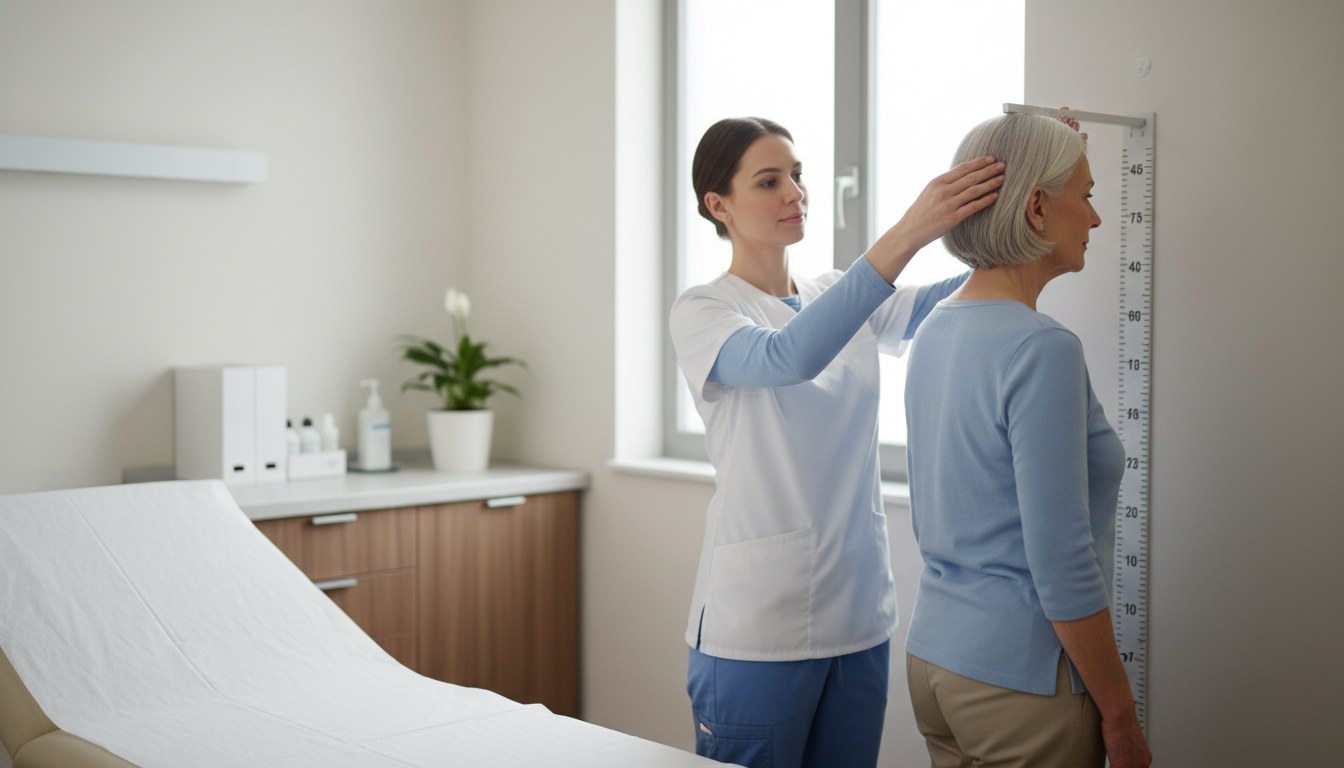
You are shorter than you used to be. Vertebrae that quietly compress make you measurably shorter, so height is the most useful clue you can track yourself. Compare with your tallest adult height, the number on an old driver's license. More than about 1.5 inches lost from that peak, or 0.8 inch between two office measurements, needs looking into. Measure the same way each time: shoes off, heels to a wall, eyes level.
Your upper back has rounded forward. Stand with heels, buttocks, and shoulder blades against a wall and look straight ahead. If the back of your head cannot comfortably reach the wall, the upper spine has curved, usually because vertebrae have wedged at the front.
Clothes fit differently around your middle. As the spine shortens, the rib cage settles toward the pelvis. Waistbands ride up, shirts feel long, and a belly appears with no weight gain. Lay your fingers flat between your lowest rib and the top of your hip bone; a gap under two fingers is worth showing a clinician.
Sudden back pain from a trivial movement. A vertebral compression fracture often starts while emptying a laundry basket, sneezing, or missing a step. The pain sits in the mid or lower back, is sharp rather than achy, worsens standing or walking, and eases lying flat. No fall is required. Most are quieter still and turn up by accident on a chest X-ray ordered for something else, one reason the diagnosis comes late. Back pain has many ordinary causes, and Causes of Lower Back Pain covers them.
Grip, breathing, and your mouth. Grip strength tends to track with bone density, so jar lids and heavy doors getting harder is a soft signal. A curved upper back leaves the chest less room, so breathing feels tight. The jaw thins too, and receding gums, loose teeth, or a denture that stops fitting are sometimes noticed first.
The First Fracture Is Often the First Symptom
Doctors use the phrase fragility fracture for a bone broken by a force that should not have broken it: a fall from standing height or less after age 50, a rib cracked by a hard cough, a vertebra that collapses during ordinary bending. Any of these can suggest the bone was already weak.
Where they happen first. The wrist is usually earliest, because the reflex when you slip is to put out a hand, often in the fifties and sixties. Spine, hip, upper arm, pelvis, and ribs follow. A broken wrist at 58 gets treated as a wrist problem, the cast comes off, and nobody orders a bone density scan. That is the most fixable failure in this subject. After any low-trauma break, ask whether you should be evaluated for osteoporosis: one fracture strongly predicts the next, and the risk runs highest in the first year or two. Fewer falls closes part of the gap, and How to Prevent Falls at Home for Older Adults covers the home changes.
The breaks that cannot wait. A hip fracture usually needs surgery within a day or two; delay raises the risk of blood clots, pneumonia, and permanent loss of independence. A collapsing vertebra can push bone into the spinal canal, where pressure on the cord or nerve roots causes lasting weakness, numbness, or loss of bladder and bowel control unless it is relieved quickly. A cracked rib can tear or collapse a lung. A fall that also strikes your head is more dangerous on a blood thinner, because bleeding around the brain builds over hours behind a normal-seeming first hour. A bent limb, a bone through the skin, or a hand or foot below the injury turning cold, pale, or numb can suggest blood supply or nerves are compromised and requires urgent medical evaluation. Severe back pain with fever or shaking chills points instead to infection in the spine, and back pain with unintended weight loss, night pain, or a past cancer diagnosis needs imaging before anyone blames osteoporosis.
Who Should Be Screened Before a Bone Breaks
The test is a DXA scan, a low-dose X-ray of the hip and spine. You lie still on a padded table for ten to fifteen minutes. The result is a T-score compared with a healthy young adult: minus 1.0 or above is normal, minus 1.0 to minus 2.5 is low bone mass or osteopenia, and minus 2.5 or below is osteoporosis. Many clinicians add a FRAX score, folding in age, weight, history, and habits to estimate ten-year fracture probability.
Who is routinely screened. The U.S. Preventive Services Task Force recommends screening all women 65 and older, and postmenopausal women under 65 whose formal risk assessment puts them at comparable risk. The Bone Health and Osteoporosis Foundation also advises testing men 70 and older, and anyone over 50 who has already had a fragility fracture.
Reasons to be tested sooner. A parent who broke a hip. Menopause before 45, ovaries removed early, or periods that stopped for months without pregnancy. Prednisone or another oral steroid daily for three months or longer. An aromatase inhibitor for breast cancer, or androgen deprivation therapy for prostate cancer. Celiac disease, inflammatory bowel disease, rheumatoid arthritis, an overactive thyroid or parathyroid, chronic kidney disease, type 1 diabetes, or a history of anorexia. Smoking, more than two alcoholic drinks most days, or a very light body frame. Long-term proton pump inhibitors and some anti-seizure drugs count too; raise these with your prescriber rather than stopping anything yourself.
One mix-up is worth clearing up: osteoporosis thins bone and causes no joint pain, while osteoarthritis wears cartilage and causes stiff, aching joints. You can have both, and stiff knees say nothing about bone density. Osteoarthritis: Causes, Symptoms, and Management covers that one separately.
When to Seek Medical Care
When to Seek Urgent or Emergency Care
Thinning bone by itself is usually not an emergency, and a rounding back typically does not need a 911 call. What makes this topic urgent is the moment a weakened bone breaks, because a few of those breaks damage nerves, lungs, or blood supply within hours. This guidance is in addition to, not a replacement for, the general disclaimer above.
Emergency, call 911 or go to the emergency room immediately if:
- After a fall you cannot put weight on one leg and the hip or groin hurts badly, or that leg looks shorter or turns outward at the foot. That is how a broken hip presents.
- Back pain comes with numbness, tingling, or weakness in a leg, numbness around the groin or inner thighs, or new trouble controlling your bladder or bowels, which can mean a collapsed vertebra is pressing on the spinal cord.
- You have trouble breathing, a stabbing chest pain with every breath, or you cough up blood after a fall, a hard coughing spell, or a blow to the ribs, because a broken rib can collapse a lung.
- You hit your head in the fall and take a blood thinner, or you become confused, vomit repeatedly, turn unusually drowsy, or your headache keeps worsening over the next few hours.
- A limb looks bent or out of place after a minor fall, a bone has broken through the skin, or the hand or foot below the injury turns cold, pale, or numb.
- Severe back pain arrives with fever, shaking chills, or drenching night sweats, which suggests infection in the spine rather than a simple compression fracture.
See a doctor soon (same-day or next available appointment) if:
- You have broken any bone from a fall at standing height or less since turning 50, including a wrist, rib, upper arm, or pelvis, and nobody has ordered a bone density scan.
- New mid-back or low-back pain started during an ordinary movement such as lifting groceries or sneezing, and it is worse standing and better lying flat.
- You have lost more than about 1.5 inches from your tallest adult height, or an office measurement is noticeably shorter than your last one.
- Your upper back has visibly rounded, your waistband rides up without weight gain, or the gap between your lowest rib and the top of your hip is under two fingers.
- Back pain comes with weight loss you did not intend, pain that wakes you at night, or a past cancer diagnosis, since those point away from ordinary osteoporosis.
- You are a woman 65 or older, or a man 70 or older, and have never had a bone density scan.
- You have taken prednisone or another oral steroid daily for three months or longer, or you are on an aromatase inhibitor or androgen deprivation therapy.
- You went through menopause before age 45, had your ovaries removed early, or your periods stopped for several months with no pregnancy.
Frequently Asked Questions
Does osteoporosis itself hurt?
Thinning bone produces no pain of its own. Pain comes from a fracture, most often a vertebra that has compressed, or from muscle strain in a spine that has changed shape. Ongoing aches with a normal scan usually have another cause.
Can a blood test detect osteoporosis?
No blood test diagnoses it; density is measured with a DXA scan. Your doctor may still order blood work to look for drivers of bone loss: low vitamin D, calcium problems, thyroid or parathyroid disease, kidney disease, or celiac disease.
Is osteopenia the same as osteoporosis?
They are points on one scale. Osteopenia means density is below normal but above the osteoporosis threshold. Plenty of fractures happen in people with osteopenia, so treatment decisions weigh your fracture history and overall risk, not the number alone.
Can bone loss be reversed once it starts?
Some of it can be regained. Weight-bearing and resistance exercise, adequate calcium and vitamin D, quitting smoking, and prescription medication raise density and lower fracture risk. What cannot be undone is a vertebra that has already collapsed, which is why catching it early matters.
Do brittle nails or thinning hair mean I have osteoporosis?
Not on their own. Nail and hair changes have many everyday causes and are not reliable signs of bone loss. Height loss, a newly rounded upper back, and a bone broken by a minor fall are the signals worth acting on.
Do men get osteoporosis?
Yes. Men lose bone more gradually and tend to fracture about a decade later than women, and are less likely to be screened or treated afterward. Low testosterone, long-term steroid use, heavy drinking, and prostate cancer treatment all raise the risk.
How much calcium and vitamin D do I actually need?
The National Institutes of Health Office of Dietary Supplements sets daily calcium at 1,000 mg for most adults and 1,200 mg for women over 50 and men over 70, with vitamin D at 600 IU up to age 70 and 800 IU after that. Food sources first; ask your clinician before adding high-dose supplements.
Related articles
Causes of Lower Back PainOsteoarthritis: Causes, Symptoms, and ManagementHow to Prevent Falls at Home for Older AdultsSources
- National Institute of Arthritis and Musculoskeletal and Skin Diseases (NIAMS, NIH) - Osteoporosis
- MedlinePlus (National Library of Medicine, NIH) - Osteoporosis
- U.S. Preventive Services Task Force - Recommendation: Osteoporosis to Prevent Fractures: Screening | United States Preventive Services Taskforce
- Bone Health and Osteoporosis Foundation: Clinician's guide to prevention and treatment of osteoporosis.
- NIH Office of Dietary Supplements - Office of Dietary Supplements - Calcium
- Mayo Clinic - Osteoporosis - Symptoms and causes