Is It Just a Cold or RSV in My Baby?
A runny nose, cough and mild fever in a baby are often a common cold, and respiratory syncytial virus (RSV) can look the same at first. The difference that matters is breathing.
Written By: DocAi Health Editorial Team
Last Updated: 2026-10-04
A runny nose, cough and mild fever in a baby are often a common cold, and respiratory syncytial virus (RSV) can look the same at first. The difference that matters is breathing. Fast or labored breathing, pulling in at the ribs, pauses in breathing, a blue or gray color, or poor feeding can point to RSV affecting the lungs and need urgent care. This article explains how to compare the two, what to watch, and how to comfort your baby.
Is it just a cold or RSV in my baby? Why they look alike
Both illnesses are caused by viruses that infect the nose and throat. In the early days, a baby with a cold and a baby with RSV can both have a stuffy or runny nose, a mild cough, sneezing and a lower appetite. You usually cannot tell them apart by looking at the first day or two of symptoms.
MedlinePlus, from the National Library of Medicine, describes RSV infections as a common cause of respiratory illness. In many children and adults it causes mild, cold-like symptoms. In young infants, and especially in babies born early or with heart or lung conditions, it can spread to the lower airways and cause more serious illness.
Because a test is not needed for most mild colds, many babies are never told which virus they had. What matters most at home is how hard your baby is working to breathe and how well they are feeding.
How RSV can differ from a cold
A cold stays mostly in the nose and throat. RSV can travel down into the small airways of the lungs. Inflammation and mucus in those narrow tubes can cause illness called bronchiolitis, and in some babies pneumonia. Several factors, including age, prematurity and underlying health conditions, contribute to how sick a baby becomes.
Signs that suggest the illness may have moved beyond a simple cold include:
- A wet or wheezy cough that gets worse instead of settling
- Wheezing, a whistling or rattling sound when breathing out
- Faster breathing than usual, even when calm or asleep
- Flaring nostrils or a head that bobs with each breath
- Skin pulling in between or under the ribs, or at the base of the throat
- Feeding much less than normal, or tiring and stopping during feeds
Fever can occur with both. A fever alone does not tell you which virus it is, and in babies 3 months or older the number on the thermometer is less informative than your baby's breathing, alertness and feeding. In a baby under 3 months old, a fever is handled differently, as described below.
What a typical cold looks like in a baby
Most baby colds cause a clear or cloudy runny nose, congestion, occasional sneezing, a mild cough and sometimes a low fever. The baby is usually still interested in feeding, still has some periods of alertness, and breathes comfortably when the nose is cleared.
Nose congestion matters because babies breathe mostly through their noses. A blocked nose can make feeding hard and sleep restless, even when the lungs are fine. A useful check is whether breathing looks easier after you clear the nose with saline drops and gentle suction. Breathing that stays fast or labored after the nose is clear deserves more attention.
How to check your baby's breathing at home
Undress your baby's chest and watch for a minute while they are calm, ideally not crying or feeding. Look for these things:
- Effort: the ribs or the soft spot under the breastbone sinking in with each breath.
- Nostrils: widening with each breath.
- Sound: grunting at the end of a breath, wheezing, or a high-pitched noise.
- Color: lips, tongue or face looking bluish or gray.
- Pauses: gaps in breathing, especially in young infants.
Counting breaths can be helpful, but normal rates vary with age and activity, and a number alone should not decide your next step. Describe what you see and what your baby's breathing rate was to your pediatrician or nurse line, who can interpret it for your baby's age.
Dehydration and feeding problems
Babies with RSV sometimes struggle to feed because they cannot breathe and suck at the same time. If they take in too little fluid, they can become dehydrated, and young babies can become dehydrated more easily than older children. Watching wet diapers and fluid intake is a practical way to notice this. Fewer wet diapers than usual, a dry mouth, no tears when crying and a baby who is feeding less than usual call for a same-day call to your pediatrician. Our article on signs of dehydration goes through these in more detail.
Some signs suggest severe dehydration and need emergency care: very few or no wet diapers over many hours (ask your pediatrician for the cutoff for your baby's age), a sunken soft spot on the head, sunken eyes, unusual sleepiness or refusing all feeds. Go to the emergency room now if you see them.
Offering smaller, more frequent feeds can help some babies with milder feeding trouble. Tell your pediatrician if feeding is clearly reduced, so they can decide whether your baby needs to be examined.
Who is at higher risk of severe RSV
Any baby can become seriously ill, but certain groups are more likely to need hospital care. These include very young infants, babies born prematurely, and babies with chronic lung disease, congenital heart disease or weakened immune systems. Exposure to tobacco smoke and crowded settings such as child care can also play a part.
If your baby is in one of these groups, tell your pediatrician early in any respiratory illness, even when symptoms look mild.
The CDC's page on RSV in infants and young children describes two ways to protect babies: an RSV vaccine given during pregnancy, or an RSV antibody product given to the baby. Which option fits, and when, depends on the baby's age, the time of year and whether the baby is entering a first RSV season, so ask your pediatrician or obstetric clinician what is appropriate for your family. Our article on flu, Tdap and RSV vaccines in pregnancy covers that topic separately.
How doctors evaluate it
Clinicians combine your baby's history, a physical examination and, in some cases, oxygen level measurement. A test for RSV may be done in some settings, but many babies with bronchiolitis are diagnosed from the story and examination alone. Chest X-rays and blood tests are not needed for every child and are used when the picture is unclear or the illness is more severe.
Flu and COVID-19 can also cause similar symptoms in babies. MedlinePlus has an overview of the flu, and your clinician may test for it depending on the season and your baby's condition.
Comfort care at home for a mild illness
Most mild cases are managed with supportive care, which means helping your baby breathe and feed more comfortably while the body clears the virus.
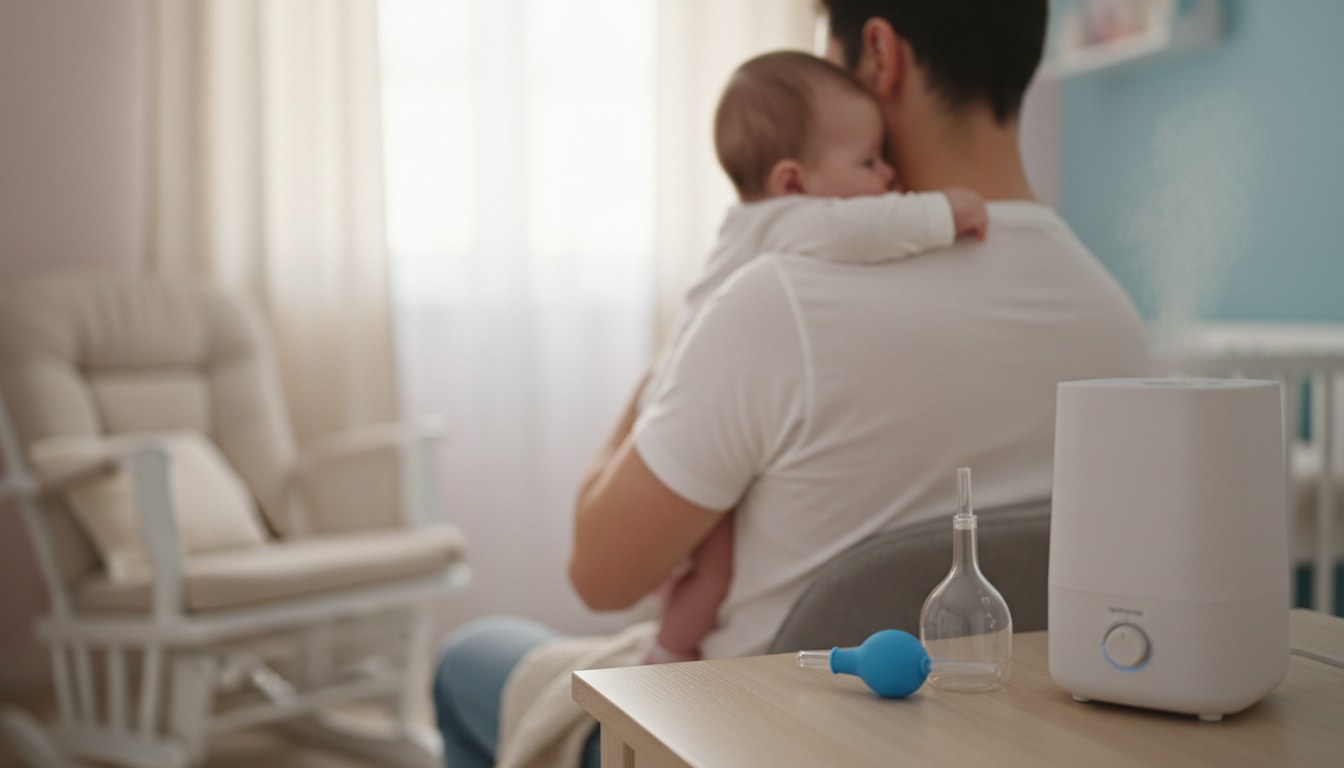
- Clear the nose: saline drops followed by gentle bulb suction, particularly before feeds and sleep.
- Keep fluids up: breast milk or formula in smaller, more frequent feeds.
- Use a cool-mist humidifier: clean it as directed by the manufacturer.
- Hold your baby upright: this can ease breathing and feeding for some babies.
- Keep smoke away: cigarette smoke and vaping aerosol can worsen breathing.
Antibiotics do not work on viruses such as RSV or the cold, and your clinician will prescribe them only if a separate bacterial infection is suspected. Our article on why antibiotics do not help a cold or the flu explains this.
Fever and cough medicine in babies
Pediatricians advise prompt medical evaluation for a rectal temperature of 100.4°F (38°C) or higher in a young infant, and the exact approach varies with age in weeks. For a baby under 3 months old, go to the emergency room rather than waiting for a routine appointment, because young infants can have serious infections that look mild at first. Your pediatrician or nurse line can help direct where to go, but do not treat it at home first. Call 911 instead if the baby is also limp, blue, struggling to breathe or hard to wake.
For a baby 3 months or older, call your pediatrician the same day for a fever that lasts or keeps returning, a fever that goes away and then comes back, or any fever with poor feeding, unusual sleepiness or breathing trouble. Ask your pediatrician which temperature should prompt a call for your baby's age.
Do not give over-the-counter cough and cold medicines to babies and young children without your pediatrician's advice. MedlinePlus's page on medicines and children reminds caregivers to read labels carefully and ask a doctor or pharmacist about the right product and amount for a child's age and weight. We cover this in cough and cold medicine for young children.
Medicine cautions that apply to babies:
- Do not give acetaminophen (Tylenol) or any other fever medicine to a baby under 3 months old unless a clinician tells you to, and check the label and ask your pediatrician or pharmacist before giving it to an older baby.
- Do not give ibuprofen (Motrin, Advil) to a baby under 6 months old. For older babies, check the label and ask your pediatrician or pharmacist, especially if your baby is feeding poorly or may be dehydrated.
- Manufacturers label over-the-counter cough and cold medicines "do not use" in children under 4 years old. They have not been shown to help young children and can cause serious harm, so give them only if a clinician advises it.
- Do not give aspirin to babies or children.
- Do not give honey to a baby under 1 year old.
For an older baby, follow the product label and ask your pediatrician or pharmacist before giving any fever medicine. Do not calculate doses yourself.
How long it lasts and how it spreads
Colds usually improve over about a week or so, though a cough can linger. RSV illness varies. Symptoms often worsen over the first several days before improving, and a cough can last a few weeks. Call your pediatrician if breathing or feeding gets worse, if your baby is no longer improving, or if they get worse after seeming better.
Both viruses spread through droplets from coughing and sneezing and through contact with contaminated hands and surfaces. Washing hands, cleaning toys and surfaces, keeping sick visitors away from newborns, and avoiding kissing a baby's face when you are unwell can reduce spread. Adults with a mild cold can still pass RSV to a baby.
When to get medical help
Trust your instincts. If your baby looks like they are struggling to breathe, seems unusually limp, or you are worried, seek care. The emergency box below lists the signs that need 911 or the emergency room now, and the signs that call for a same-day call or visit.
When to Seek Medical Care
When to Seek Urgent or Emergency Care
RSV can make it hard for a baby to get enough oxygen or fluid, and these signs show up in breathing, color, alertness and feeding. Use the first list for 911 or the emergency room now, and the second for same-day or next-available care. This guidance is in addition to, not a replacement for, the general disclaimer above.
Emergency, call 911 or go to the emergency room immediately if:
- Your baby has blue, purple or gray lips, tongue or face, or pauses in breathing, gasps or stops breathing, even briefly, which can mean they are not getting enough oxygen.
- Your baby is working very hard to breathe, with deep pulling in of the chest or ribs, grunting, or flaring nostrils that do not ease, or cannot feed or swallow because of struggling to breathe.
- Your baby is extremely limp, hard to wake, does not respond to you as usual, or has a seizure.
- Your baby has a fever with a stiff neck or a bulging soft spot, or is inconsolably irritable and very unwell: go to the emergency room now, and call 911 if your baby is hard to wake or struggling to breathe.
- Your baby shows signs of severe dehydration, such as very few or no wet diapers over many hours, a sunken soft spot, sunken eyes, or refusing all feeds: go to the emergency room now.
- Your baby is under 3 months old and has a rectal temperature of 100.4°F (38°C) or higher: go to the emergency room now rather than waiting for an appointment (your pediatrician or nurse line can help direct you), and call 911 if the baby is also limp, blue, struggling to breathe or hard to wake.
See a doctor soon (same-day or next available appointment) if:
- Your baby is 3 months or older and has a fever that lasts or keeps returning, or any fever with poor feeding, unusual sleepiness or breathing trouble: call your pediatrician the same day.
- Your baby is breathing faster than usual or wheezing but is alert, pink and feeding: call your pediatrician or nurse line now for same-day advice, and go to the emergency room if breathing looks labored or feeding stops.
- Your baby is feeding much less than normal, or has noticeably fewer wet diapers, a dry mouth or no tears when crying.
- Your baby has a cough or congestion that is getting worse instead of better, or seems to improve and then worsen again.
- Your baby was born early or has a heart, lung or immune condition and develops a respiratory illness, even a mild one.
- Your baby has ear pain signs, such as pulling at the ear with fever, or symptoms that are not improving after several days.
Frequently Asked Questions
How can I tell if my baby has RSV or just a cold?
Early on, you often cannot tell them apart because both cause a runny nose, cough and mild fever. Breathing is the better clue. Wheezing, fast or labored breathing, rib retractions and poor feeding suggest the illness may be affecting the lungs. A clinician can examine your baby and decide whether testing is useful.
Can adults with a cold give RSV to a baby?
Yes. In older children and adults RSV often causes only cold-like symptoms, so an adult may not realize it is RSV. The virus spreads through droplets and contaminated surfaces. Washing hands, avoiding face kisses when you are ill, and keeping sick visitors away from newborns can reduce the chance of passing it on.
When does RSV get worse in babies?
Symptoms often worsen over the first several days, and a cough can last a few weeks, though the course varies. A cough that becomes wetter, wheezing, faster breathing or poor feeding can signal progression. If breathing or feeding gets worse, or your baby improves and then worsens, call your pediatrician.
Does my baby need antibiotics for RSV?
Usually not. RSV and the common cold are caused by viruses, and antibiotics treat bacteria. Clinicians may prescribe an antibiotic if they suspect a separate bacterial problem, such as an ear infection or bacterial pneumonia. Treatment of mild RSV is mainly supportive, meaning clearing the nose, offering fluids and monitoring breathing.
Is a fever normal with RSV?
Fever can occur with RSV, colds, flu and many other infections, so it does not identify the cause. A rectal temperature of 100.4°F (38°C) or higher in a baby under 3 months old needs emergency evaluation now. For older babies, breathing, alertness and feeding matter more than the number. Ask your pediatrician or pharmacist about fever medicine first.
Can I give my baby cough medicine?
Do not give over-the-counter cough and cold medicines to babies or young children without checking with your pediatrician or pharmacist first. Read the label, which lists age limits, and ask about the right product for your child. Comfort measures like saline drops, gentle suction, a cool-mist humidifier and plenty of fluids are generally preferred.
How do I know if my baby is dehydrated from RSV?
Signs include fewer wet diapers than usual, a dry mouth, no tears when crying, a sunken soft spot, and unusual sleepiness. Babies who struggle to breathe may feed less and lose fluid faster. Very few or no wet diapers over many hours, a sunken soft spot or refusing all feeds need the emergency room.
Which babies are at higher risk of serious RSV?
Very young infants, babies born prematurely, and babies with chronic lung disease, congenital heart disease or weakened immune systems are more likely to become seriously ill. Smoke exposure and crowded settings can contribute. If your baby is in a higher-risk group, tell your pediatrician early in any respiratory illness, even a mild one.
Related articles
Bronchitis or Pneumonia: How Do You Know Which One You Have?Sinus Infection or Just a Cold? How to Tell the DifferenceSigns of Dehydration You Shouldn't Ignore: What to Watch ForSources
- MedlinePlus (NIH) - Respiratory Syncytial Virus Infections
- MedlinePlus (NIH) - Flu
- MedlinePlus (NIH) - Medicines and Children
- CDC - RSV in Infants and Young Children