Postpartum Anxiety: Symptoms New Moms Often Mistake for Normal Worry
Postpartum anxiety is an umbrella term for anxiety that begins or worsens after birth, not a single diagnosis, and it is treatable. It can bring racing thoughts, constant checking, physical tension, and dread that persists even when the baby is fine.
Mental HealthPostpartum Mental Healthpregnancy-guidance
Written By: DocAi Health Editorial Team
Last Updated: 2026-09-30
Last Updated: 2026-09-30
Medical Disclaimer: This article is for general informational and educational purposes only and is not medical advice. It does not create a doctor-patient relationship and is not a substitute for professional diagnosis or treatment by a qualified healthcare provider. Never disregard or delay seeking professional medical advice because of something you have read here. If you think you may have a medical emergency, call 911 or your local emergency number right away. Health information can change and this guidance is general and US-focused, so consult a licensed clinician in your own country about your specific situation.
Postpartum anxiety is an umbrella term for anxiety that begins or worsens after birth, not a single diagnosis, and it is treatable. It can bring racing thoughts, constant checking, physical tension, and dread that persists even when the baby is fine. A 2025 review in The Lancet Psychiatry estimated that about 12.3 percent of women worldwide are affected, though figures depend on how anxiety is defined and measured. What matters clinically is whether the worry is excessive or hard to control and disrupts sleep, daily life, relationships, or care of yourself or the baby. Partners and non-birthing parents can be affected. This article covers the signs, why it gets missed, and when to get help.
What Postpartum Anxiety Actually Feels Like
Postpartum anxiety can be more than ordinary worry. It often includes racing or looping thoughts that circle back to the same fear, such as something happening to the baby, a missed illness, or failing as a mother, and a background hum of dread that does not fully switch off, even during a nap or a bath. Physical symptoms are common and often get mistaken for something else: a pounding or skipping heart, a tight chest, shaky hands, an upset stomach, or a wired, jittery feeling. Many of these sensations overlap with anxiety generally (see Physical Symptoms of Anxiety People Don't Realize), but thyroid problems after childbirth and other conditions can cause the same symptoms (see Can a Thyroid Problem Cause Anxiety or Depression?), so new physical symptoms deserve a clinician's check.
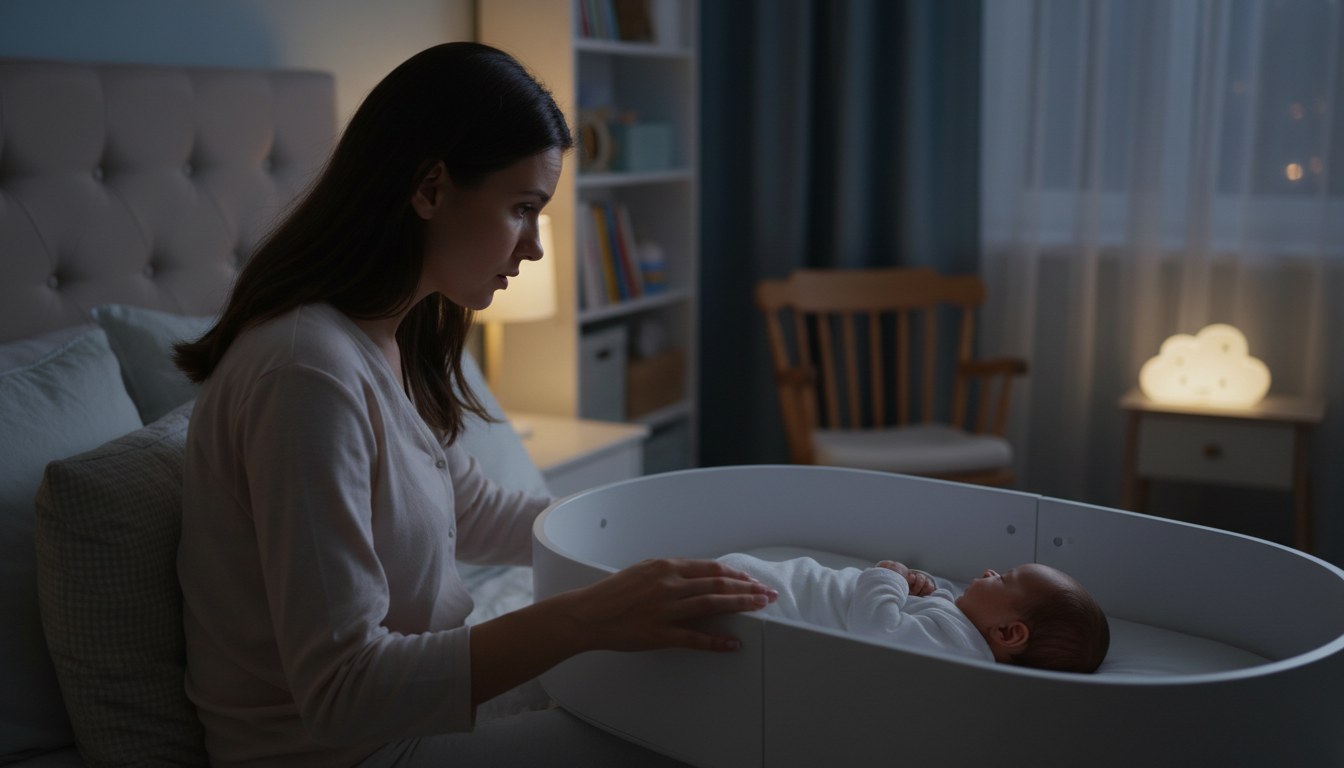
Sleep is a major casualty. A mother with postpartum anxiety often cannot fall asleep even when someone else is watching the baby, because her mind keeps running through what could go wrong. Checking behaviors are another common feature: getting up several times a night to confirm the baby is breathing, re-checking the car seat straps, or repeatedly searching symptoms online that a pediatrician already answered. Some mothers have panic attacks, sudden waves of intense fear with a racing heart, sweating, and a feeling of losing control, sometimes triggered by a brief separation from the baby (see Panic Attacks and Panic Disorder: Symptoms and Treatment).
Why It Gets Written Off as Normal New-Mom Worry
New parents are told to expect some worry, and a fragile newborn makes some worry realistic. That expectation makes postpartum anxiety easy to miss. A more useful question is how much room the worry takes up, how hard it is to control, and what it costs you. Typical new-parent concern is usually proportional: you check on the baby, you get reassurance, and the worry eases. With postpartum anxiety, the worry can stay high for long stretches, come back quickly after being calmed, or show up as physical symptoms with no clear cause.
Cultural expectation reinforces the blind spot, because new mothers are often told anxiety comes with the job. ACOG's screening page summarizes its Clinical Practice Guideline 4, which recommends screening for both depression and anxiety at the first prenatal visit, later in pregnancy, and at postpartum visits, using standardized, validated instruments.
If anxious thoughts keep you from sleeping even when you have the chance, keep you from leaving the house, or make ordinary tasks like feeding or bathing the baby feel unmanageable, that is worth raising with a clinician, not a phase to wait out on your own.
How It Differs From Related Postpartum Conditions
Several postpartum conditions get lumped together. ACOG describes perinatal anxiety disorders as a range of conditions, including generalized anxiety, panic, and social anxiety. It reports generalized anxiety in about 6 to 8 percent of women in the first 6 months after delivery and panic disorder in about 0.5 to 3 percent of women 6 to 10 weeks postpartum, and overall estimates differ because studies define and measure anxiety differently.
- Baby blues are common and temporary: mood swings, tearfulness, and mild anxiety in the first days after delivery. ACOG estimates they occur in up to 85 percent of new mothers and usually resolve on their own within about two weeks; seek help sooner if symptoms are severe or getting worse.
- Postpartum depression involves persistent sadness, loss of interest, guilt, or low energy, and can overlap with anxiety, but the core feature is usually a low or depressed mood rather than fear. See Postpartum Depression vs. the "Baby Blues": How to Tell the Difference.
- Postpartum anxiety centers on excessive worry, physical tension, and a sense of looming danger, and can occur with or without depression.
- Postpartum OCD involves unwanted, repetitive, intrusive thoughts or images, which can include harming the baby, paired with compulsions like repeated checking or avoiding being alone with the baby. Mothers usually find these thoughts horrifying, and having one does not by itself mean you want to harm your baby or will act on it: a 2022 study of 388 postpartum women found no evidence that these thoughts, or OCD, were linked to a higher risk of physical aggression toward the infant. Because similar symptoms occur in different conditions, a clinician should assess the thoughts, intent, compulsions, insight, and overall mental state. See Obsessive-Compulsive Disorder (OCD): Symptoms and Treatment.
If your main experience is constant worry and physical tension, this article is the closer fit. For anxiety outside the postpartum period, see Generalized Anxiety Disorder: Causes, Symptoms, and Treatment. Thoughts of harming yourself are a more urgent picture; see Warning Signs of a Mental Health Crisis and Where to Get Help.
What Causes It
Postpartum anxiety has no single cause, and it is not a character flaw. The postpartum period brings major biological changes, sleep disruption, stress, and life changes, and researchers do not yet fully understand how these factors interact. ACOG lists a personal or family history of anxiety, lack of support, a difficult pregnancy or birth, health challenges for the mother or baby, a prior pregnancy loss, and adverse childhood experiences among the factors linked to higher risk. Financial stress and breastfeeding struggles can add to the load. These factors may raise vulnerability or worsen symptoms but are not required for postpartum anxiety to occur, and none is something a mother did wrong.
When Anxiety Symptoms Point to Something More Urgent
A few postpartum presentations need faster action than a routine appointment. Postpartum psychosis is very rare (ACOG puts it at 1 to 3 in 1,000 births), but NIMH calls it a psychiatric emergency and advises calling 911 or going to the nearest emergency room. It can involve hallucinations, delusions, paranoia, confusion, or disorganized behavior, with a sudden onset, most often in the first weeks after delivery. Because people with psychosis often have poor insight, it requires immediate emergency assessment even if the mother does not recognize that anything is wrong. Distressing intrusive thoughts a mother recognizes as unwanted can occur with OCD, while hallucinations, fixed false beliefs, severe confusion, or loss of contact with reality raise concern for psychosis and need emergency assessment.
Separately, some of the same physical sensations anxiety causes can come from postpartum preeclampsia, a blood pressure disorder that ACOG says most often appears in the first few days after delivery but can occur up to 6 weeks later, even when blood pressure was normal during pregnancy. ACOG advises calling your doctor right away for a blood pressure reading of 140/90 mm Hg or higher, changes in vision, a headache that will not go away, shortness of breath, swelling of the face or hands, or pain in the upper right belly or shoulder. A reading of 160/110 mm Hg or higher is in the severe range and needs emergency care. The CDC's HEAR HER campaign also lists chest pain, trouble breathing, fainting, and severe leg swelling or pain. Postpartum preeclampsia is less common than anxiety, but untreated it can cause stroke and seizures, so new severe symptoms at any point after delivery need to be checked rather than assumed to be anxiety.
Getting a Diagnosis
No blood test can diagnose postpartum anxiety, though a clinician may check thyroid function and blood counts for physical contributors. Diagnosis usually begins with a conversation with an obstetric clinician, primary-care clinician, midwife, or mental-health professional, so be specific about the thoughts, the physical symptoms, how often they occur, and what they stop you from doing. A concrete description of how symptoms affect your sleep, daily activities, and caregiving, such as "I have not slept more than two hours at a time in weeks because I keep checking on the baby," helps your clinician assess severity. Clinicians may use validated screening tools such as the GAD-7 or the Edinburgh Postnatal Depression Scale, depending on the symptoms. These questionnaires support assessment but do not by themselves diagnose a specific anxiety disorder, and a high score is not a verdict on you as a mother.
What Recovery Can Look Like
Many people experience improvement with appropriate treatment, but response and timing vary with the treatment, the severity of symptoms, and the individual. Some medications take several weeks to reach full benefit, and the prescriber should monitor treatment. Improvement is often uneven: panic attacks may ease first, then checking behaviors, then sleep. Expecting a gradual curve instead of an on-off switch can help mothers stay with treatment.
Treatment Options
Postpartum anxiety is treatable, and many people improve with therapy, support, medication, or a combination. Psychotherapy is an important option, and medication may also be appropriate depending on symptom severity, your preferences, how you responded to earlier treatment, and your circumstances. ACOG's clinical guidance says obstetricians can start medication for perinatal anxiety, refer patients to behavioral health care, or do both. The 2025 review found promising evidence for cognitive behavioral therapy, which teaches you to identify and interrupt anxious thought patterns, although research specific to postpartum anxiety is limited and few studies have examined medication. Support groups can reduce the isolation that makes anxiety worse.
Several commonly used antidepressants can be used during breastfeeding when clinically appropriate, and ACOG's guidance advises clinicians not to withhold or stop mental health medication because of pregnancy or lactation status alone. The choice depends on the medication, your baby's age and health, and your own history, so it should be individualized with your prescriber and, when needed, a lactation or pediatric professional rather than decided from a forum thread. Do not stop or change a prescribed medication on your own; tell your prescriber if your mood worsens or thoughts of harming yourself appear.
Practical relief matters too. Because sleep loss can feed anxiety, some families arrange an uninterrupted stretch of sleep, for example by having a partner give one feed, with a lactation professional's help if breastfeeding (see How Poor Sleep Feeds Anxiety and Low Mood: What You Can Do About It). Some mothers find relief in structured breathing or grounding techniques (see Grounding Techniques to Stop a Panic Attack) and regular movement. None of these replace treatment for significant anxiety, but they may lower day-to-day strain while therapy or medication takes effect.
What Partners and Family Can Do
The people around a new mother often notice postpartum anxiety before she names it herself: the constant checking, the trouble resting even when someone else has the baby, the reassurance-seeking that eases nothing. Naming what you are seeing, gently and without minimizing it, and offering to sit with her at an appointment can be the push that gets her seen. Telling her to relax or that the baby is fine often does not help. It helps more to ask directly, calmly, and without judgment whether she has had thoughts of harming herself or the baby. Her answer is one piece of the picture: thoughts that come with intent, a plan, a sense of losing control, hallucinations, or false beliefs are an emergency, and unwanted intrusive thoughts she finds horrifying still call for a prompt evaluation. Practical help often matters more than advice: an uninterrupted stretch of sleep, a ride to an appointment, or taking a pediatrician call off her plate.
When to Seek Medical Care
When to Seek Urgent or Emergency Care
Postpartum anxiety itself is usually not a medical emergency, but a few of the things it can resemble, or hide, are. If you are having thoughts of suicide or of harming yourself or your baby, call or text the 988 Suicide and Crisis Lifeline anytime, and call 911 if you or your baby are in immediate danger. This guidance is in addition to, not a replacement for, the general disclaimer above.
Emergency, call 911 or go to the emergency room immediately if:
- Thoughts of harming yourself or your baby together with an urge, plan, intent to act, or a sense of losing control, thoughts of harming your baby that do not feel frightening or unwanted to you, or a feeling that you cannot keep yourself or your baby safe
- Hearing or seeing things that are not there, holding firm beliefs that are not true, severe confusion, disorganized behavior, or losing touch with reality (possible postpartum psychosis, which needs emergency assessment even if the mother thinks nothing is wrong)
- A severe headache that will not go away, changes in vision such as blurring, spots, or flashing lights, pain in the upper right belly or under your right ribs, or shortness of breath (possible signs of postpartum preeclampsia, which can occur days to weeks after delivery)
- A blood pressure reading of 160/110 mm Hg or higher, especially with a severe headache, vision changes, chest pain, or shortness of breath
- Chest pain, fainting, a racing or pounding heart that does not slow down, or sudden trouble breathing, especially with a painful, swollen leg (these can signal a blood clot or heart problem, so do not assume anxiety)
- A panic attack so severe you cannot catch your breath or speak, especially if it is the first time this has happened to you (treat trouble breathing as a possible physical emergency first)
See a doctor soon (same-day or next available appointment) if:
- Thoughts of hurting yourself, even without a plan or intent to act: call or text 988 now, and tell your clinician the same day
- Unwanted, repeating thoughts about the baby being harmed that you find horrifying and have no wish to act on (tell your clinician right away so they can assess them)
- Anxiety that keeps you from sleeping even when someone else is caring for the baby, or that is getting in the way of eating, feeding the baby, leaving the house, or basic self-care
- New, recurrent, severe, or disruptive panic attacks
- Checking behaviors, on the baby's breathing, on locks, on appliances, that take up a large part of your day or night
- New, persistent, or worsening physical symptoms such as a racing heart, trembling, or stomach upset, which should be checked rather than assumed to be anxiety
- A blood pressure reading of 140/90 mm Hg or higher after delivery, even without symptoms and below the 160/110 range above (ACOG advises calling your doctor right away)
Frequently Asked Questions
Is postpartum anxiety different from normal new-mom worry?
It can be. Ordinary new-parent worry is usually proportional: it rises with a real concern and eases with reassurance. Postpartum anxiety can stay high for long stretches, return quickly after being calmed, or show up as physical symptoms with no clear cause. What matters is whether the worry is excessive or hard to control and disrupts daily life.
How soon after birth does postpartum anxiety start?
Postpartum anxiety can begin soon after delivery or later in the postpartum period. ACOG says perinatal anxiety can start immediately after delivery through about 6 weeks postpartum, and may also begin during pregnancy or after weaning. Baby blues usually resolve within about two weeks, so anxiety that lasts longer or keeps getting worse is worth raising with a clinician, and severe symptoms deserve help sooner.
Can postpartum anxiety happen without postpartum depression?
Yes, the two conditions can occur separately or together. Postpartum anxiety centers on excessive worry, physical tension, and a sense of impending danger, while postpartum depression centers on persistent sadness, low energy, and loss of interest. A mother can have significant anxiety with no depressed mood at all, which is one reason it gets missed.
Are intrusive thoughts about the baby normal?
Brief, unwanted thoughts about something bad happening to the baby are common and do not by themselves signal a problem. An unwanted intrusive thought or image about harming your baby does not by itself mean you want to harm your baby or will act on it. If the thoughts repeat, distress you, or come with rituals like constant checking, a clinician should assess the thoughts, intent, compulsions, insight, and overall mental state.
Is postpartum anxiety the same as postpartum OCD?
They are related but not the same. Postpartum anxiety involves general worry and physical tension, while postpartum OCD involves intrusive, repetitive thoughts or images, often with compulsions such as repeated checking. Both are treatable, and a clinician can tell them apart by assessing the thoughts, intent, compulsions, insight, and overall mental state.
Can I take anxiety medication while breastfeeding?
Several commonly used antidepressants can be used during breastfeeding when clinically appropriate. The choice depends on the medication, the dose, your baby's age and health, and your own history, so it should be individualized with your prescriber and, when needed, a lactation or pediatric professional. Tell your prescriber that you are breastfeeding, and do not stop or change a prescribed medication on your own.
How long does postpartum anxiety last if it is not treated?
Without treatment, ACOG says perinatal anxiety can last from weeks to months or longer, and ongoing sleep loss and stress can make recovery harder. Many people improve with appropriate therapy, support groups, or medication when appropriate, and the timing varies with the treatment, the severity of symptoms, and the individual.
Can partners get postpartum anxiety too?
Yes. Partners, including fathers and non-birthing parents, can also develop anxiety or depression after a baby arrives, often alongside sleep loss and disrupted routines. Symptoms can go unnoticed because attention usually centers on the birthing parent. The same warning signs apply, and a clinician can help.
Related articles
Generalized Anxiety Disorder: Causes, Symptoms, and TreatmentPhysical Symptoms of Anxiety People Don't RealizeWarning Signs of a Mental Health Crisis and Where to Get HelpSources
- ACOG - Summary of Perinatal Mental Health Conditions
- ACOG - Patient Screening
- ACOG - Assessment and Treatment of Perinatal Mental Health Conditions
- National Institute of Mental Health (NIMH) - Perinatal Depression
- Lancet Psychiatry (PubMed) - Postpartum anxiety: a state-of-the-art review
- J Clin Psychiatry (PubMed) - Postpartum Thoughts of Infant-Related Harm and Obsessive-Compulsive Disorder: Relation to Maternal Physical Aggression Toward the Infant
- CDC HEAR HER Campaign - Urgent Maternal Warning Signs and Symptoms
- ACOG - 3 Conditions to Watch for After Childbirth