What Do Newborn and Childhood Hearing Tests Show, and What if a Child Doesn't Pass?
Newborn hearing screening results show whether a baby's ear and hearing nerve responded to soft sounds. A "pass" suggests hearing is likely within the typical range at that moment.
Written By: DocAi Health Editorial Team
Last Updated: 2026-10-01
Newborn hearing screening results show whether a baby's ear and hearing nerve responded to soft sounds. A "pass" suggests hearing is likely within the typical range at that moment. A "refer" or "did not pass" result does not mean a child is deaf, because fluid, a blocked ear canal or a noisy room can affect it, but it does mean prompt follow-up testing is needed. This article explains the tests, how to read childhood hearing test results, and what happens next.
What newborn hearing screening results show
A hearing screening is a quick check that sorts children into two groups: those whose results look typical and those who need a closer look. It does not diagnose hearing loss. A diagnostic evaluation by a pediatric audiologist does that, by combining the child's history, an ear examination and more detailed testing.
MedlinePlus, from the National Library of Medicine, describes hearing problems in children and notes that early detection matters because hearing supports speech and language development. You can read more on its page Hearing Problems in Children.
Screening is usually done in the hospital before a baby goes home. Later checks happen at well-child visits, at school, or sooner if a parent or clinician has a concern.
The two newborn screening methods
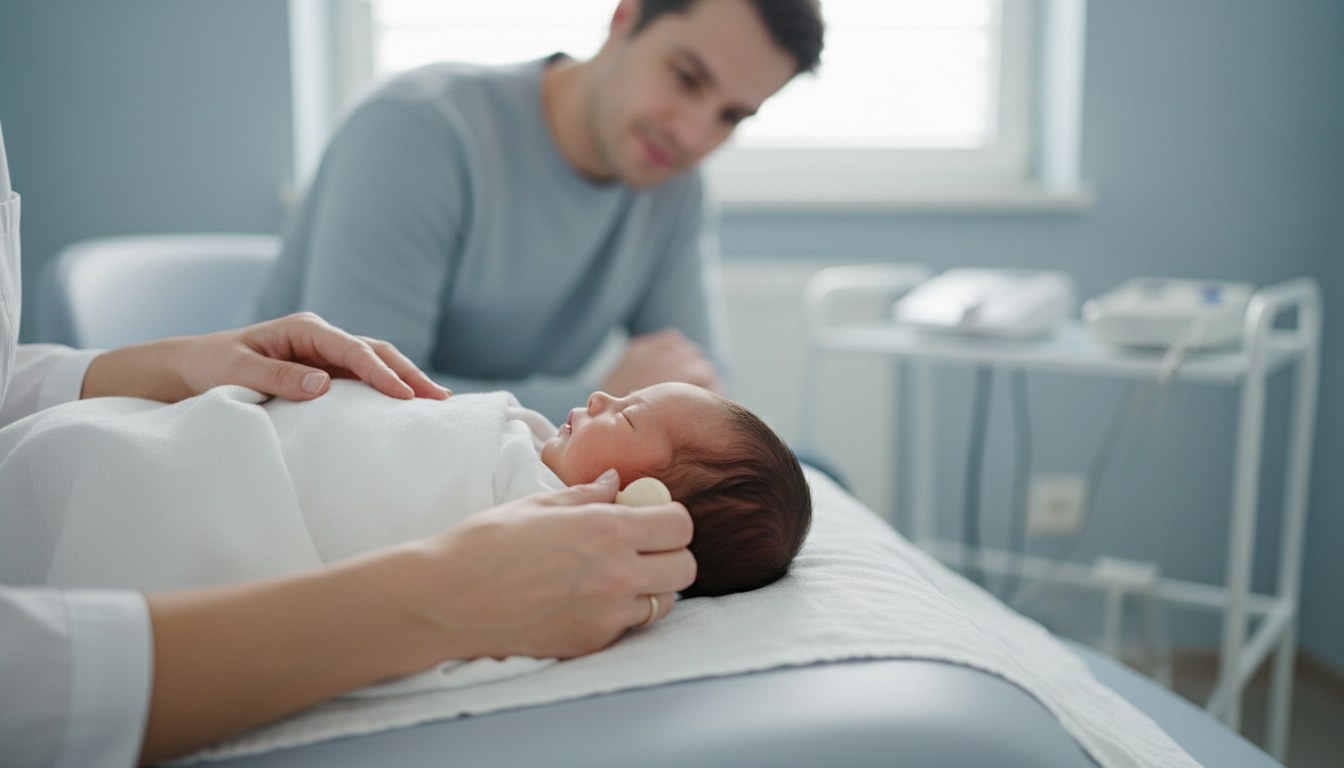
Two painless tests are used for newborns. Both can often be done while a baby sleeps or rests quietly.
Otoacoustic emissions (OAE)
A tiny soft probe sits at the opening of the ear canal and plays gentle clicks or tones. When the inner ear (the cochlea) works typically, it produces a faint echo that the probe picks up. A missing echo can be associated with hearing loss, but it can also occur when the ear canal contains fluid or debris from birth.
Automated auditory brainstem response (AABR)
Small sensors are placed on the baby's head, and soft earphones play sounds. The sensors record how the hearing nerve and brainstem respond. This test looks further along the hearing pathway than OAE, so some programs use it for babies who spent time in a neonatal intensive care unit.
Which test a hospital uses varies. Ask the hospital or your pediatrician which one your baby had.
What a "refer" result means
Results are usually reported as "pass" or "refer," sometimes for each ear separately. A refer result is common enough that it should not be read as a diagnosis. Several factors can contribute:
- Fluid or vernix in the ear canal or middle ear, especially in the first days of life.
- A baby who was moving, crying or feeding during the test.
- Background noise in a busy hospital room.
- A probe that did not seal well in a very small ear canal.
- Permanent hearing loss, which is much less common than these temporary causes but is the reason the screening exists.
Because a single refer result cannot tell these apart, the next step is a repeat screening or a diagnostic evaluation, depending on the program and the baby's history. Arrange it as soon as the program can schedule it. Follow-up that is missed or put off is a common reason hearing loss is found late.
What happens after a child does not pass
State Early Hearing Detection and Intervention programs often work toward a general goal summarized as 1-3-6: screening by one month, diagnosis by three months and early intervention by six months. Your state program and your child's clinicians set the exact plan, so follow the schedule they give you and check with your pediatrician for the current guidance in your state.
A typical path looks like this:
- Rescreen. A repeat OAE or AABR, sometimes at the hospital and sometimes at an outpatient clinic.
- Diagnostic audiology visit. A pediatric audiologist runs a more detailed ABR test, often while the baby sleeps naturally, and may add tests that check how well the middle ear moves.
- Medical evaluation. A pediatrician or an ear, nose and throat (ENT) specialist looks for treatable causes such as middle ear fluid.
- Support if hearing loss is found. Options can include hearing aids, other hearing devices and early intervention services for language. The right choice depends on the type and degree of loss and on the family's goals.
If your baby did not pass, it is reasonable to ask the clinician which ear was involved, which test was used, and when the follow-up is due.
Risk factors that may prompt closer monitoring
Some babies pass the newborn screening and still need ongoing hearing checks, because hearing loss can appear or progress later. Your pediatrician can decide on follow-up for babies with factors that are associated with a higher chance of hearing loss, including:
- A family history of childhood hearing loss.
- Time in a neonatal intensive care unit, particularly a longer stay.
- Certain infections during pregnancy or after birth, including congenital cytomegalovirus (CMV). Some programs test for congenital CMV when a baby does not pass the newborn hearing screen, so ask your pediatrician whether your state program does.
- Certain medicines given to a newborn that can affect hearing, and a high bilirubin level that needed an exchange transfusion.
- Certain genetic conditions, such as Down syndrome, and conditions that affect the shape of the ear or face, such as craniofacial microsomia.
- Repeated or long-lasting ear infections and middle ear fluid in childhood.
If your child has any of these, tell your pediatrician so they can decide whether extra hearing checks are appropriate. A genetic counselor can also discuss inherited causes; see MedlinePlus on Genetic Counseling.
Hearing tests for older infants, toddlers and school-age children
The type of test changes with age and with how well a child can take part.
- Behavioral observation. For infants, an audiologist watches how the baby reacts to sounds, such as turning toward them or pausing.
- Visual reinforcement audiometry. For babies and toddlers, a sound plays and the child learns to turn toward it for a visual reward, such as a lit toy.
- Play audiometry. For toddlers and preschoolers, the child does a simple task, like dropping a block in a bucket, each time they hear a tone.
- Pure-tone audiometry. For school-age children, headphones play tones at different pitches and the child raises a hand or presses a button. The results are plotted on a chart called an audiogram.
- Tympanometry. A probe in the ear canal checks how the eardrum moves, which can show middle ear fluid.
A school screening that a child does not pass also calls for a follow-up evaluation, not a conclusion. Colds, allergies and ear infections can cause temporary changes in a result.
Reading an audiogram in plain terms
An audiogram shows the softest sound a child responds to at each pitch. Lower pitches are on the left and higher pitches on the right. Softer sounds are near the top and louder sounds lower down. Audiologists describe the degree of loss, such as mild, moderate, severe or profound, and the type:
- Conductive: sound has trouble passing through the outer or middle ear. Fluid and earwax are common examples, and this type is often temporary or treatable.
- Sensorineural: the inner ear or hearing nerve is affected. This type is usually long-lasting.
- Mixed: features of both.
Hearing loss can affect one ear or both. Even a loss in one ear can make understanding speech in noise harder, so it is still worth evaluating.
Signs to watch for even after a passed screening
A passed screening reflects hearing at one point in time. Tell your pediatrician if you notice:
- A baby who does not startle at loud sounds or does not turn toward voices as they get older.
- Delayed or unclear speech, or fewer new words than you expected.
- A child who often says "what?", turns the television up, or seems not to listen.
- Trouble following directions in noisy places, or falling behind at school.
- Repeated ear pain, ear drainage or ear infections.
Hearing concerns can look like inattention or behavior problems, and hearing loss can be overlooked for that reason. Developmental concerns have several possible causes; see MedlinePlus on Developmental Disabilities and Baby Health Checkup.
Sudden hearing change and ear emergencies
Most hearing concerns in children are not emergencies, but a few presentations need urgent evaluation. The emergency and same-day tiers are listed in the box below. Sudden hearing loss in a child needs an urgent in-person evaluation the same day. Hearing change after a head injury, or ear symptoms alongside signs of a serious infection, can progress quickly and should not wait for a routine visit. A fever of 100.4°F (38°C) or higher in a baby younger than 3 months also needs prompt in-person emergency evaluation, with or without ear symptoms, so do not wait for a same-day phone call.
Living with the result and getting support
If a diagnosis of hearing loss is made, many families feel overwhelmed at first. Early intervention services for language and communication are usually coordinated through the audiologist, pediatrician and state programs. Ask your care team about family-centered early intervention. One qualitative study explored professionals' perspectives on assessing parent-child interaction with deaf infants. Outcomes vary from child to child, and a child's care team can explain the options that fit your family.
When to Seek Medical Care
When to Seek Urgent or Emergency Care
Most hearing screening problems are not emergencies, but a few ear and hearing symptoms in a child can signal a serious condition and need immediate care. The lists below separate what needs 911 or the emergency room now from what needs a prompt visit. This guidance is in addition to, not a replacement for, the general disclaimer above.
Emergency, call 911 or go to the emergency room immediately if:
- Go to the emergency room now if your child has a stiff neck, severe headache or unusual sleepiness along with ear pain, hearing change or fever, and call 911 if your child is hard to wake or you cannot get there safely, because this can suggest a serious infection around the brain.
- Call 911 if your child has a seizure, becomes hard to wake, or is confused after an ear infection or head injury.
- Call 911 if your child has sudden weakness of one side of the face, trouble speaking or loss of balance together with a hearing change.
- A baby younger than 3 months with a rectal temperature of 100.4°F (38°C) or higher, with or without ear symptoms, needs prompt in-person emergency evaluation; call 911 if you cannot get there safely.
- Go to the emergency room now if your child has swelling, redness and pain behind the ear that pushes the ear forward, as this can be a sign of infection spreading beyond the ear.
- Go to the emergency room now if hearing changes after a significant head injury, especially with vomiting, drainage of blood or clear fluid from the ear, or drowsiness.
See a doctor soon (same-day or next available appointment) if:
- Seek an urgent in-person evaluation the same day if your child has sudden hearing loss in one or both ears without other emergency signs, by calling your pediatrician or going to urgent care or the emergency room if you cannot be seen.
- Arrange a rescreen or diagnostic audiology evaluation as soon as possible if your newborn did not pass the hearing screening, in line with the 1-3-6 goal of diagnosis by 3 months of age. Do not wait to see whether your baby seems to hear fine.
- Call your pediatrician the same day for ear pain with fever, ear drainage, or unusual fussiness and ear tugging in a child 3 months or older; younger babies with fever need the emergency room instead.
- Schedule a hearing evaluation soon if your child has delayed speech, does not respond to voices, or has repeated ear infections or fluid behind the eardrum.
- Tell your pediatrician promptly if your child passed screening but you still worry about their hearing, so they can decide whether further testing is appropriate.
Frequently Asked Questions
Does a newborn hearing test hurt?
No. Both common newborn screening methods are painless. One uses a soft probe at the ear opening, and the other uses small sensors on the head with soft earphones. Many babies sleep through the test. Your baby may be asked to stay still or calm for a few minutes, and the hospital team can explain which method they use.
What does it mean if my baby got a refer result?
A refer result means the screening did not show the expected response, so more testing is needed. It does not diagnose hearing loss. Fluid in the ear, a movement during the test or background noise can all play a part. A rescreen or a visit with a pediatric audiologist helps clarify what is going on.
Can a baby pass the screening and still have hearing loss later?
Yes. Screening reflects hearing at one point in time, and some types of hearing loss appear or progress later. Infections, certain genetic conditions, ear problems and other factors may contribute. If you notice speech delay or limited response to sound, tell your pediatrician so they can decide whether a hearing evaluation is appropriate.
Can ear fluid cause a failed hearing test?
Yes. Fluid or debris in the ear canal or middle ear can reduce the response a screening picks up, which is a common reason for a refer result in newborns and a changed result in older children. Because fluid can be temporary, clinicians often repeat the test and may check how the eardrum moves.
What is the difference between a screening and a diagnostic hearing test?
A screening is a quick check that sorts children into pass or refer. A diagnostic test, done by a pediatric audiologist, measures hearing more precisely, often at different pitches and in each ear, and helps identify the type and degree of any loss. Clinicians combine the test results with the child's history and an ear examination.
Is hearing loss in one ear a problem?
It can be. Hearing in only one ear can make it harder to understand speech in noisy places or to tell where sounds come from. Some children with one-sided loss do well, and others need support at school. A pediatric audiologist and your pediatrician can discuss whether monitoring or treatment makes sense for your child.
When should an older child have a hearing test?
Hearing is often checked at well-child visits and at school, and sooner if you or a teacher notice concerns such as unclear speech, missed directions or turning the volume up. Children with risk factors may need more frequent checks. Ask your pediatrician which schedule fits your child.
Does CMV infection affect newborn hearing?
Congenital cytomegalovirus can be associated with hearing loss in some babies, including loss that appears later. Some programs test for CMV when a baby does not pass the newborn screen. Talk with your pediatrician about whether testing or extra hearing checks are appropriate for your baby.
Related articles
Why Is There Blood in My Urine But It Doesn't Hurt?Why Doesn't Losartan Cause the Same Cough as Lisinopril?Why Do Children Get Blood Lead Tests, and What Do the Results Mean?Sources
- MedlinePlus (NIH) - Hearing Problems in Children
- MedlinePlus (NIH) - Baby Health Checkup
- MedlinePlus (NIH) - Developmental Disabilities
- MedlinePlus (NIH) - Genetic Counseling
- PubMed Central (NIH) - "It doesn't matter if we're the most amazing professionals in the world…" A qualitative study of professionals' perspectives on parent-child interaction assessment with deaf infants