Why Do My Ankles Swell More by the End of the Day?
Ankles that look normal in the morning and puffy by dinner often reflect dependent edema, caused by fluid pooling in the lower legs after hours of sitting or standing. The swelling usually eases after you lie flat overnight.
Medical Conditionsleg and ankle swellingsymptom-check
Written By: DocAi Health Editorial Team
Last Updated: 2026-09-30
Last Updated: 2026-09-30
Medical Disclaimer: This article is for general informational and educational purposes only and is not medical advice. It does not create a doctor-patient relationship and is not a substitute for professional diagnosis or treatment by a qualified healthcare provider. Never disregard or delay seeking professional medical advice because of something you have read here. If you think you may have a medical emergency, call 911 or your local emergency number right away. Health information can change and this guidance is general and US-focused, so consult a licensed clinician in your own country about your specific situation.
Ankles that look normal in the morning and puffy by dinner often reflect dependent edema, caused by fluid pooling in the lower legs after hours of sitting or standing. The swelling usually eases after you lie flat overnight. That daily pattern is common, but it does not by itself rule out an underlying condition. Swelling is worth medical attention when it no longer goes down overnight, spreads above the ankle, is painful or one-sided, or comes with shortness of breath.
Why Gravity Targets Your Ankles by Evening
Standing or sitting upright works against your circulation. Blood has to travel back up from your legs against gravity all day long, and your body relies on a return system to make that happen. The veins below your knee handle the job with a series of one-way valves and the pumping action of your calf muscles. The calf muscles help pump blood upward through the leg veins with each step, while the valves help prevent it from flowing backward. When you sit at a desk, stand at a register, or sit through a long flight, your calf muscles do little pumping. Pressure inside the leg veins can climb, and some fluid gets pushed out through the capillary walls into the soft tissue around your ankle and foot. That fluid is what you feel as puffiness by dinnertime.
MedlinePlus notes that the effect of gravity makes leg swelling most noticeable in the lower part of the body, and that long airplane flights or car rides, as well as standing for long periods, often lead to some swelling in the feet and ankles. The ankle and lower shin are the lowest point on your body for most of the day and the point farthest from your heart, where the return system has to work hardest, so swelling often shows up there first.
This is called dependent edema because the fluid collects in the part of your body that is lowest, or most dependent on gravity, for the longest stretch of the day. In this pattern the main driver is mechanical, meaning gravity combined with slow blood return from the legs, although other conditions can add to it (covered below). Lie down overnight and the fluid redistributes, so ankles often look close to normal again by morning.
The shape of your day can help you and your clinician sort out the cause. Ankles that are flat in the morning, puffy by evening, and flat again after a night's sleep fit the dependent edema pattern. This daily pattern is common, but it does not by itself rule out an underlying condition, because chronic venous insufficiency and some other conditions can also swell more as the day goes on. Swelling that is already present when you wake up, especially around the eyes or face, can have causes other than dependent edema, including kidney disease, medication effects, or other conditions that affect the whole body, and should be interpreted alongside your other symptoms.
Everyday Habits That Make It Worse
A handful of ordinary choices can push more fluid into your ankles on any given day:
- Sitting or standing still for hours. Desk jobs, long car rides, and long flights are common contributors, because your calf muscles do little pumping while you stay in one position.
- Heat. Warm weather and hot showers widen the small blood vessels near your skin, which can let more fluid leak into the surrounding tissue.
- A salty meal. Sodium pulls water with it, and a high-sodium lunch or dinner can show up as tighter shoes by evening.
- Alcohol. Alcohol can contribute to fluid-balance changes and may worsen swelling in some people, particularly when combined with salty foods or prolonged sitting or standing.
- Tight waistbands, crossed legs, or snug socks. Anything that presses on a vein at one point can slow return flow from everything below it.
These habits are not usually dangerous on their own. If you can point to a long flight, a salty dinner, or a day on your feet, and the swelling goes down again, one of these habits may be the explanation. If the swelling keeps returning or gets worse, mention it to your clinician.
Medications That Can Cause or Worsen Ankle Swelling
Several medicines can cause or worsen ankle swelling. MedlinePlus lists blood pressure medicines called calcium channel blockers, nonsteroidal anti-inflammatory drugs (NSAIDs), steroids, hormones such as estrogen, and some antidepressants among them. If evening ankle swelling is new and you recently started or changed a medication, the timing is worth mentioning to your prescriber. Common culprits include:
- Calcium channel blockers for blood pressure, such as amlodipine or nifedipine, widen small arteries more than they widen veins, which can push fluid into the tissue around the ankle. Swelling is a well-recognized side effect of this drug class.
- NSAIDs like ibuprofen or naproxen, taken regularly rather than occasionally, can cause the kidneys to hold onto more sodium and water.
- Oral corticosteroids such as prednisone can also cause fluid retention, particularly at higher doses or with longer-term use.
- Hormone therapy and some antidepressants can also contribute in some people.
Do not stop a prescribed medication on your own. Call the prescriber or pharmacist, describe the swelling and when it started, and let them decide whether a dose change or a switch makes sense.
Life Stages and Conditions Behind the Pattern
Mild, symmetric swelling of the feet and ankles is common in pregnancy, especially later on, as extra blood volume and pressure from the growing uterus slow return flow from the legs (see our guide to swelling in the third trimester). Sudden or marked swelling, particularly of the face or hands, calls for prompt medical assessment for preeclampsia.
ACOG lists swelling of the face or hands, a headache that will not go away, changes in eyesight, pain in the upper abdomen or shoulder, sudden weight gain, and difficulty breathing among the possible symptoms of preeclampsia, and advises calling your ob-gyn right away if you have any of them. Facial or hand swelling together with a headache that will not go away, vision changes, upper abdominal pain, or trouble breathing needs care right away, either from your obstetric provider or in an emergency room (see the emergency guidance below).
Chronic venous insufficiency (CVI) is what doctors call it when the valves in the leg veins wear out or get damaged over months and years, often alongside visible varicose veins. Early on, the swelling can look just like gravity swelling and improve overnight. Over time it can become more persistent, and the skin near the ankle can become discolored or itchy. Standing for a living, a prior blood clot, being overweight, and older age all raise the odds.
Lymphedema happens when the lymph system is damaged or blocked, so lymph fluid builds up in the soft tissues. MedlinePlus lists scar tissue from radiation therapy or surgical removal of lymph nodes, infection, cancer, and inherited conditions among its causes, and notes that it usually happens in the arms or legs. Unlike ordinary dependent edema, it can affect one limb more than the other, and the swelling often persists rather than clearing with an overnight rest, particularly as it progresses.
Ankle swelling can also be one clue pointing toward the heart, kidneys, or liver, though those causes often come with other signs beyond a worse evening pattern. Swelling accompanied by new or worsening shortness of breath, rapid weight gain, difficulty breathing when lying flat, or waking at night short of breath can occur with heart failure and warrants medical evaluation. NHLBI lists swelling in the ankles, feet, and legs, weight gain, trouble breathing, and being unable to sleep lying flat among the symptoms of heart failure. Chest pain, pressure, or tightness alongside the swelling is a reason to call 911, and a racing heartbeat alongside the swelling needs prompt medical attention (see the emergency guidance below).
If swelling comes with reduced urination or foamy urine, see our guide on the early signs of kidney trouble. If it comes with an enlarged abdomen, yellowing skin, or easy bruising, see our guide on warning signs your liver may be struggling. New one-sided leg swelling, especially with pain, warmth, or redness, can be a sign of deep vein thrombosis (DVT) and should be assessed promptly, so read about the early signs of a blood clot in the leg rather than assuming it is gravity. A clot that breaks loose can travel to the lungs and cause sudden chest pain or shortness of breath, which is a medical emergency.
What Actually Helps
For ordinary evening swelling, a few low-effort habits may help:
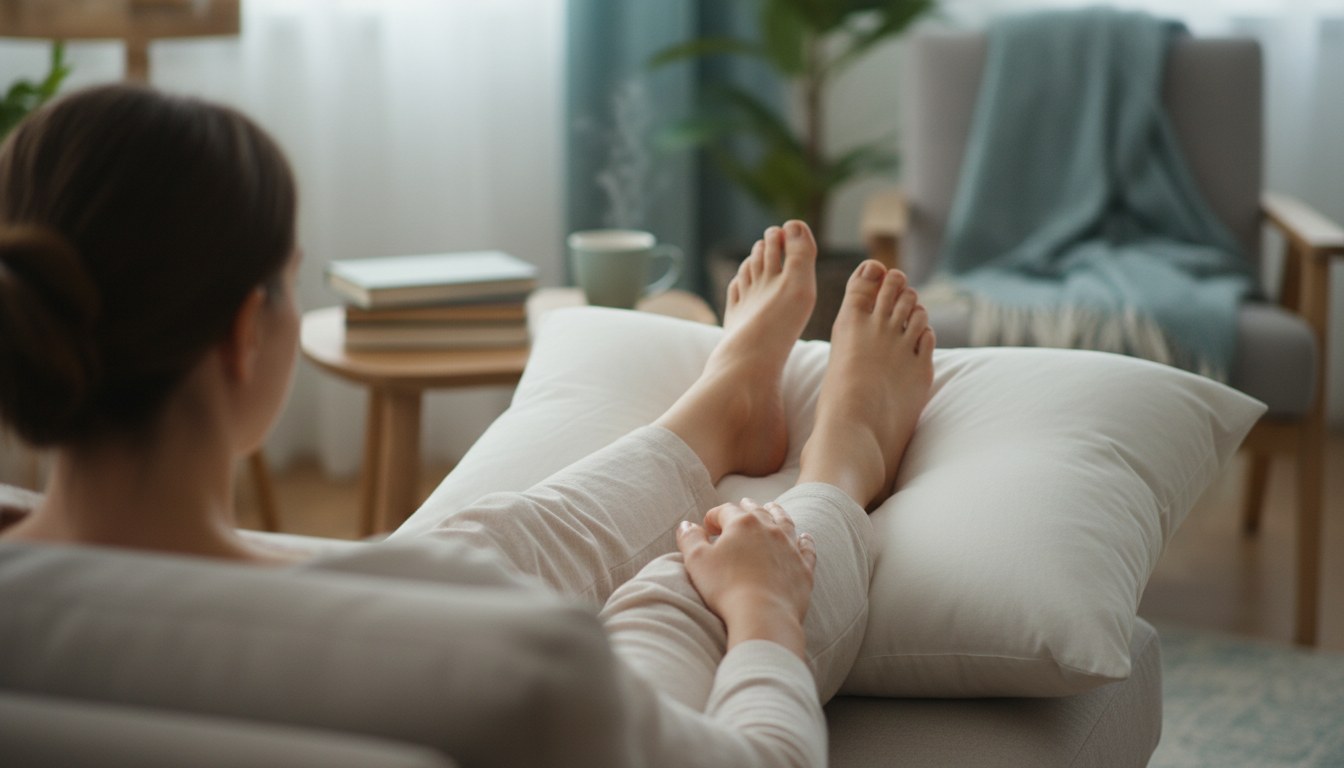
- Raise your legs above heart level a few times a day. For vein problems, MedlinePlus suggests 3 or 4 times a day for 5 to 15 minutes at a time. Lying on a couch with your calves resting on the armrest or a stack of pillows is one way to do it.
- Move your calf muscles regularly. If your job keeps you seated, stand and walk for a couple of minutes at regular intervals, or do ankle circles and calf raises at your desk. If your job keeps you standing, shift your weight and walk a short loop when you can.
- Consider graduated compression stockings. Moderate over-the-counter compression socks, often sold in the 15 to 20 mmHg range and worn during the hours you are upright, may help some people with dependent or venous swelling. People with suspected peripheral artery disease, significant circulation problems, unexplained one-sided swelling, or certain heart conditions should speak with a clinician before using compression, and a clinician or pharmacist can help with strength and fit.
- Consider cutting back on added salt on high-swelling days, and limiting alcohol. A low-salt diet may reduce fluid buildup and swelling.
- Loosen anything that presses on a vein, including tight socks, restrictive shoes, and a habit of sitting with your legs crossed.
- Check with a clinician before using over-the-counter water pills. Diuretics can have side effects and can mask the pattern a clinician needs to see, and swelling without a known cause should be evaluated before a diuretic is started.
Give any single change some time before judging whether it is working, and keep track of which days are worse so you can spot your own patterns. A simple daily note of what you ate, how long you sat or stood, and how puffy your ankles felt by evening can help you and your clinician see what makes the swelling better or worse. If these steps do not help, or the swelling gets worse, contact your clinician.
Telling Ordinary Swelling From a Different Pattern
Dependent edema is typically symmetric, meaning both ankles swell a similar amount, is fully or mostly gone by morning, and is tied to an obvious cause like a long flight or a salty meal. Swelling that breaks from that pattern, meaning it is one-sided, no longer improves overnight, keeps getting worse over time, or shows up with pain, redness, shortness of breath, or a fast heartbeat, deserves a closer look rather than another night of raising your legs and hoping. Even swelling that fits the ordinary pattern is worth mentioning to your clinician if it keeps returning, because chronic venous insufficiency and other conditions can look similar at first.
When to Seek Medical Care
When to Seek Urgent or Emergency Care
Evening ankle swelling is often related to gravity and long periods of sitting or standing. A few presentations are different: they can signal something dangerous happening right now, such as a problem in the lungs, heart, or a vein deep in the leg. This guidance is in addition to, not a replacement for, the general disclaimer above.
Emergency, call 911 or go to the emergency room immediately if:
- Sudden swelling in one leg along with new chest pain, sharp pain when you breathe in, or sudden shortness of breath, which can mean a clot has traveled to the lungs
- Severe shortness of breath, especially when lying flat, together with rapidly worsening ankle or leg swelling and a racing heartbeat
- One leg that is suddenly swollen, hot, and deeply painful, especially after a recent flight, surgery, or days spent mostly in bed
- Chest pain, pressure, or tightness together with ankle swelling, whether or not it comes with sweating, nausea, or a racing heartbeat
- In pregnancy: sudden or severe swelling of the face or hands together with a headache that will not go away, vision changes, upper abdominal pain (often under the ribs on the right side), or trouble breathing
See a doctor soon (same-day or next available appointment) if:
- New, one-sided ankle or leg swelling, even without severe pain; get it checked the same day, since it can be a blood clot
- Swelling that spreads upward from the ankle into the calf or above
- Skin over the swollen area that looks red or feels warm or tender
- Rapid unexplained weight gain over several days, especially together with worsening leg swelling or shortness of breath
- Swelling that no longer improves overnight, is progressively worsening, or has no obvious explanation
- New or worsening shortness of breath with everyday activity, or needing extra pillows to sleep comfortably
- In pregnancy: swelling that comes on suddenly, seems more than mild, or involves the face or hands, even without other symptoms; call your prenatal provider right away rather than waiting for a routine visit
Frequently Asked Questions
Why do my ankles swell more after sitting all day at work?
When you sit still, your calf muscles are not squeezing blood back up your legs, so pressure builds in the lower veins and pushes fluid into the tissue around your ankle. Standing up and walking for a few minutes at regular intervals, and raising your legs at lunch, can help interrupt the buildup before it turns into visible swelling by evening.
Is it normal for only one ankle to swell more than the other?
Ordinary dependent edema from gravity is usually close to symmetric in both ankles. Swelling that is clearly worse in one leg is not typical gravity swelling and can have several causes, including injury, infection, or lymphedema. New one-sided swelling, especially with pain, warmth, or redness, can be a sign of deep vein thrombosis (DVT) and should be assessed promptly.
Can drinking more water reduce ankle swelling?
Staying normally hydrated supports healthy fluid balance, but drinking extra water is not a treatment for edema and can be harmful for some people with heart or kidney conditions. Avoid deliberately restricting fluids or dramatically increasing them unless a clinician has advised you to do so. Cutting back on salty foods and alcohol is a more common adjustment for evening swelling.
Do compression socks actually help with evening ankle swelling?
They may help some people. A moderate over-the-counter compression sock, worn during the hours you are upright, applies gentle pressure that helps push fluid back toward the heart instead of letting it pool at the ankle. People with suspected peripheral artery disease, significant circulation problems, one-sided swelling, or certain heart conditions should check with a clinician before using compression.
Why does my ankle swelling get worse in hot weather?
Heat widens the small blood vessels near your skin as your body works to release warmth, and that can make it easier for fluid to leak out of the capillaries into the surrounding tissue. This is one reason swelling often feels worse on hot summer days or after a long, hot shower, even without any other change in your routine.
Can a new blood pressure medication cause ankle swelling?
Yes. Calcium channel blockers such as amlodipine are a well-known cause of new ankle swelling, because they widen small arteries more than veins and can push extra fluid into the surrounding tissue. If swelling starts after a new prescription, tell your doctor or pharmacist rather than stopping the medication on your own.
How long should ankle swelling from a long flight take to go away?
There is no single timeline. Swelling related to prolonged sitting often improves after normal movement and leg elevation. If it persists, becomes one-sided, or is accompanied by calf pain, warmth, redness, chest pain, or shortness of breath, seek medical evaluation, since long stretches of immobility also raise the risk of a blood clot.
Is evening ankle swelling in pregnancy something to worry about?
Mild, symmetric swelling of the feet and ankles is common later in pregnancy. Sudden or marked swelling, particularly of the face or hands, calls for prompt medical assessment for preeclampsia, especially with a severe or persistent headache, vision changes, upper abdominal pain, or shortness of breath. Contact your obstetric provider right away, or go to an emergency room if you cannot reach them.
Should I be worried if my ankle swelling has never fully gone away overnight?
Swelling that no longer resets after a full night lying flat, or that has been slowly getting worse, can suggest something beyond ordinary gravity pooling, such as chronic venous insufficiency, a heart, kidney, or liver condition, or lymphedema. It is worth a medical visit to sort out the cause.
Related articles
Early Signs of Kidney Trouble You Shouldn't IgnoreWarning Signs Your Liver May Be Struggling: What to Watch ForEarly Signs of a Blood Clot in the Leg You Should Not IgnoreSources
- MedlinePlus (NIH) - Foot, leg, and ankle swelling
- MedlinePlus (NIH) - Edema
- MedlinePlus (NIH) - Varicose and other vein problems - self-care
- MedlinePlus (NIH) - Lymphedema
- Mayo Clinic - Edema - Symptoms and causes
- NHLBI (NIH) - Heart Failure - Symptoms
- American Heart Association - Symptoms, Diagnosis, Prevention and Treatment of Venous Thromboembolism
- ACOG - Preeclampsia and High Blood Pressure During Pregnancy